3D MORPHILAR
The aim of 3D MORPHILAR is to develop patient-specific lumbar interbody implants to help restore the spine’s physiological curvature. Using motion analysis, musculoskeletal and finite element modelling, we determine the loads acting on the lumbar spine and design implants tailored to the patient’s individual anatomy. Lattice structures 3D-printed from PEEK composites and titanium are evaluated through mechanical testing and large-animal studies, contributing to the scientific foundation of safer, personalised spinal surgery.
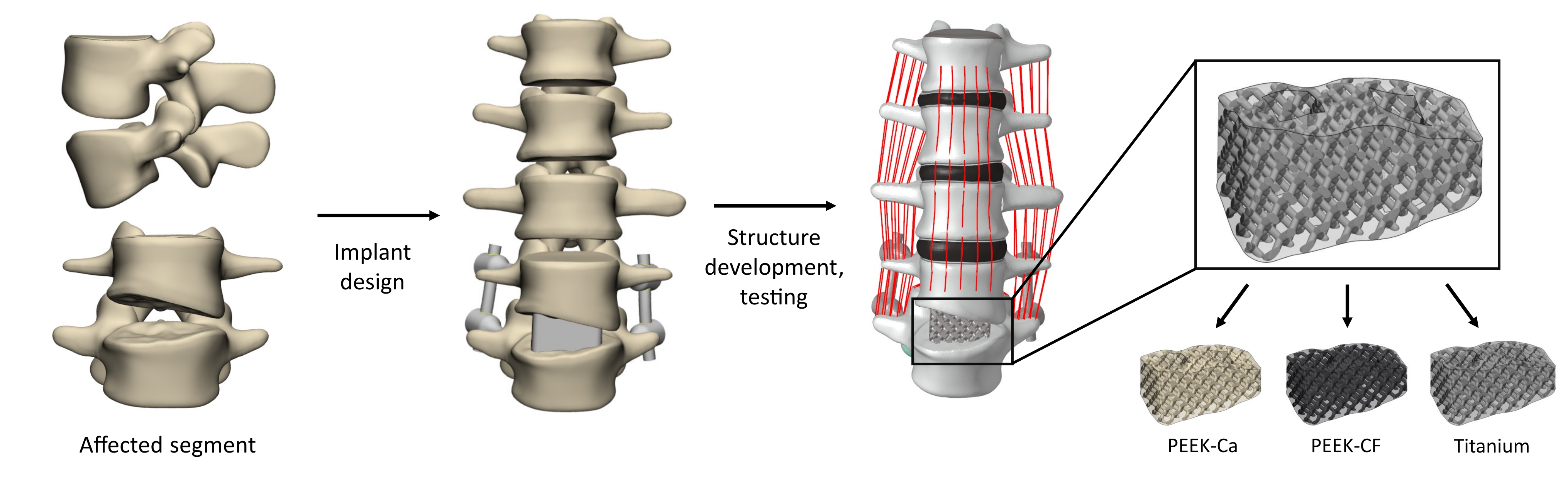
Restoring sagittal and coronal alignment is a key goal of lumbar fusion surgery. Mass-produced intervertebral cages are available in only a few standard shapes and sizes, so they often cannot follow the patient’s anatomy or correct complex deformities. This can lead to uneven loading, implant subsidence, and revision surgery.
3D MORPHILAR establishes an integrated in silico workflow for designing patient-specific lumbar implants. Motion capture and musculoskeletal modelling determine the loads acting on the spine during everyday movements. These loads are applied to our validated finite element model of the lumbar spine, in which the deformity is corrected through virtual surgery, and the implant shape is optimised.
Various lattice structures are integrated into the implant to improve load sharing and promote bone ingrowth. The lattices are 3D-printed from calcium phosphate-filled PEEK (PEEK-Ca), carbon fibre-reinforced PEEK (PEEK-CF) and titanium, and compared in vivo in a Merino sheep model using micro-CT, histology and push-out testing.
By linking simulation, manufacturing and biological validation, the project aims to establish evidence-based design guidelines for personalised, potentially metal-free spinal implants.