PASCAL: Patient-Specific Cervical Alignment restoration using in silico biomechanical methods
Principal investigator: Péter Éltes
Project Identifier: PD 143698
One of the main aims of PASCAL is to develop a method that aligns cervical spine models built from supine CT scans with the standing position using standing radiographs, thereby improving the accuracy of predictions from patient-specific finite element models. The other main direction of the project is the investigation of reconstruction following cervical corpectomy and the development of a modular, 3D-printed, patient-specific prototype of a vertebral body replacement.
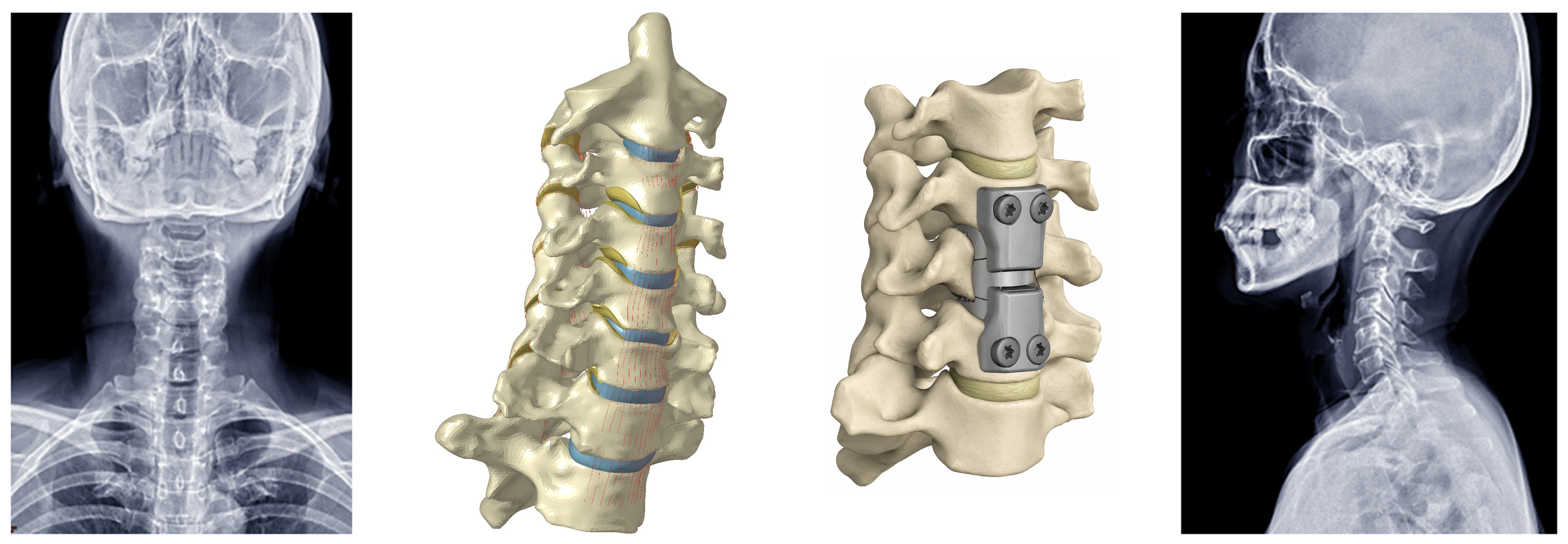
The reliability of the realignment method was evaluated in a patient cohort, demonstrating accurate and highly reproducible registration. In addition, a finite element model of the cervical spine was developed and validated within the project. A comparison of the supine and upright versions of the model showed that body position substantially affects the predicted motions, joint loads, and other biomechanical parameters.
To investigate cervical corpectomy, a virtual surgery was performed on the validated finite element model, and the surgical model was then used to compare the patient-specific implant with the conventional titanium mesh cage and plate reconstruction. With adequate stability, the anatomically conforming implant provided a larger contact area and a more favourable stress distribution at the bone–implant interface. The prototype was 3D-printed in both titanium and PEEK. A measurement protocol is also being developed based on digital image correlation (DIC) measurements on patient-specific, 3D-printed spine models, which may, in the future, support biomechanical comparisons and further development of implant designs.